
Agentic AI is AI that works toward a goal by planning steps, using tools and acting on the results, rather than only answering a single prompt. A chatbot tells you how to issue a refund; an agent can look up the order, check the policy, issue the refund and confirm it, within the limits it has been given.
What makes AI “agentic”?
Anthropic’s engineering guide Building effective agents draws a useful line between two kinds of system:
- Workflows: a language model and tools follow predefined code paths set by developers.
- Agents: the model decides its own steps and which tools to use, keeping control over how it completes the task.
Most production systems sit somewhere between the two. An agent typically combines:
- A large language model (LLM) that interprets the goal and reasons about next steps.
- Tools and APIs it can call, such as search, databases, email or a CRM. Open standards such as the Model Context Protocol give AI applications a common way to connect to these data sources and tools.
- Memory or context that tracks what has already been done.
- Orchestration code and guardrails that set limits, permissions and when to hand over to a person.
Explore our trusted partners now
How agentic AI works, step by step
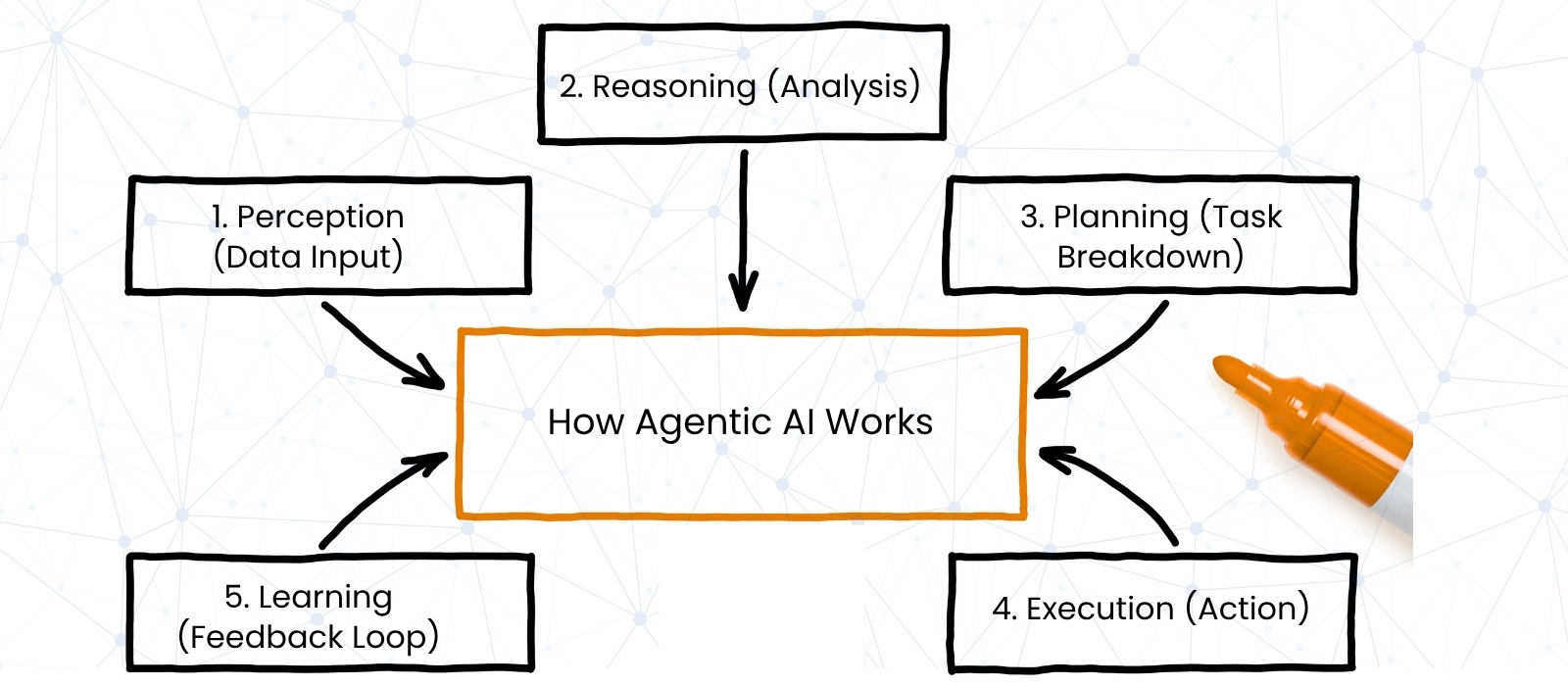
- Take in the goal and context. The agent receives a request and gathers data from users, APIs, databases or documents.
- Reason and plan. It works out what is needed and breaks the task into steps.
- Act. It calls tools or APIs to carry out each step.
- Check the result and adjust. It reviews each outcome (an error, a failed test, missing data) and changes its next step. It stops when the goal is met, a limit is reached, or a person needs to decide.
This feedback happens within a task. Agents do not usually retrain themselves between tasks; improvements over time come from developers updating prompts, tools, models and rules based on what the logs show.
Agents vs traditional automation and RPA
Agents are not the only way to automate a process. The main differences from rule-based automation and robotic process automation (RPA):
| Feature | AI agents | Traditional automation | RPA |
|---|---|---|---|
| How it decides | Model reasons about the next step | Fixed rules | Scripted steps with limited logic |
| Handles unstructured input | Yes (text, documents, images) | No | Limited |
| Task complexity | Multi-step, variable workflows | Simple repetitive tasks | Structured, rule-based tasks |
| Adapts to changes | Can adjust its plan when conditions change | No | Breaks when interfaces change |
| Predictability | Lower; outputs can vary | High | High |
| Human oversight | Needed for high-impact actions | Needed for exceptions | Needed for exceptions |
Where a process is stable and fully structured, rules or RPA are usually cheaper and more predictable. Agents earn their place where inputs vary and the next step depends on what the last one returned.
Where agents are used
Customer support
Support is one of the two areas Anthropic’s guide highlights as a natural fit, because conversations need tool access (orders, accounts) and success is easy to measure. Klarna’s assistant is the most cited case. In February 2024 the company said the assistant, built with OpenAI, handled 2.3 million conversations in its first month, two-thirds of its customer service chats, cut average resolution time from 11 minutes to under 2, reduced repeat inquiries by 25% and did work equivalent to 700 full-time agents. In May 2025 Klarna began recruiting human agents again so that customers always have the option to speak to a person, after its CEO acknowledged that the focus on cost had lowered quality. The lesson: agents can take on high volumes of routine requests, but complex cases still need people.
Software development
Coding agents write code, run tests and fix failures. Anthropic’s guide notes they work well because results can be checked with automated tests, which gives the agent clear feedback.
Finance
Agents are used to gather documents, investigate alerts and prepare reports for analysts. Real-time fraud scoring itself mostly relies on established machine learning: Visa says it used hundreds of AI models to help block $40 billion in fraudulent activity in 2024. Agentic tools tend to sit on top of such models, handling the follow-up work.
Logistics and operations
Agents can monitor orders, stock levels and shipments, re-plan routes when conditions change, and raise exceptions to staff.
Healthcare administration
Scheduling, prior-authorization paperwork and documentation are common targets, with clinical decisions left to clinicians.
How widely are agents used?
Less widely than the attention suggests. Stanford’s 2026 AI Index reports that 88% of surveyed organizations used AI in 2025, but adoption of AI agents remained in the single digits across nearly all business functions. Most organizations are still at the pilot stage.
Reliability is improving but not solved. The same report finds that AI agents rose from about 12% to roughly 66% task success on OSWorld, a benchmark of real computer tasks, yet still fail about one in three attempts. Gartner predicts that by 2028, 33% of enterprise software applications will include agentic AI and at least 15% of day-to-day work decisions will be made autonomously, both up from near zero in 2024. It also expects more than 40% of agentic AI projects to be canceled by the end of 2027 because of rising costs, unclear business value or weak risk controls.
Risks and how to control them
Anthropic’s guide warns that agents’ autonomy means higher costs and the potential for compounding errors, and recommends extensive testing in sandboxed environments. OWASP lists excessive agency among the top risks for LLM applications: damage caused when a system has more functions, permissions or autonomy than it needs. Practical controls include:
- Give the agent only the tools and permissions the task requires; prefer read-only access where possible.
- Require human approval for high-impact actions such as payments, deletions or messages to customers.
- Log every tool call and review the logs.
- Set limits on steps, spending and rate of actions.
- Protect personal data and check what the agent sends to third-party services.
How to start with agentic AI
- Pick the right task. Choose one repetitive, high-volume, well-defined process, such as support triage, data entry or reporting.
- Set a measurable goal. Decide whether you are aiming to reduce cost, cut response time or improve accuracy, and how you will measure it.
- Try the simplest option first. Anthropic advises adding complexity only when it demonstrably improves outcomes; a fixed workflow is often enough.
- Choose a platform. Look for solid APIs, compatibility with your existing systems, including older ones, and pricing that works at your expected volume once model usage fees are included.
- Integrate with minimum permissions. Connect the agent to your CRM, ERP or databases with only the access the task needs.
- Pilot alongside people. Run the agent next to your team before letting it act alone, log every action and compare results.
- Scale gradually. Expand to other teams only after the pilot meets its goal, and keep an easy route to a human for customers and staff.
What to expect next
Likely developments include multiple agents working together across systems, more back-office tasks handled by agents with human approval steps, and more agent features built into the software businesses already use. The gap between pilots and production remains large, so the organizations that benefit most will be those that pick well-defined problems, measure results and keep people accountable for outcomes.
Ready to build smarter AI-driven solutions? Explore top AI services and connect with experts.
Contact UsFrequently Asked Questions
Agentic AI is an AI system that can independently plan, decide, and execute tasks to achieve specific goals.
It works through a loop of data input, reasoning, planning, execution, and continuous learning.
Traditional AI reacts to inputs, while Agentic AI acts autonomously and completes multi-step tasks.
It is used in finance, healthcare, eCommerce, logistics, and software development.
Yes, it is considered the next stage of AI evolution, enabling autonomous systems and intelligent automation.
Written by: AIML Marketplace Team

