A CEO of a growing services company recently shared a simple frustration. The business was hitting new revenue targets, the team had doubled, and yet everyone felt busier than ever. Sales reps were updating CRM notes by hand after every call. The support team kept answering the same five questions over email. Finance was copying invoice details into spreadsheets. Managers waited days for reports. Employees searched through Slack, email, and Google Drive to find simple answers.
None of these tasks looked huge on their own. Together, they were slowing the entire business down.
Most manual work hides in plain sight. That is where AI can help. This guide explains, in plain language, how AI can reduce manual work across your business — without needing a complicated project or a full technology overhaul.
Quick Answer
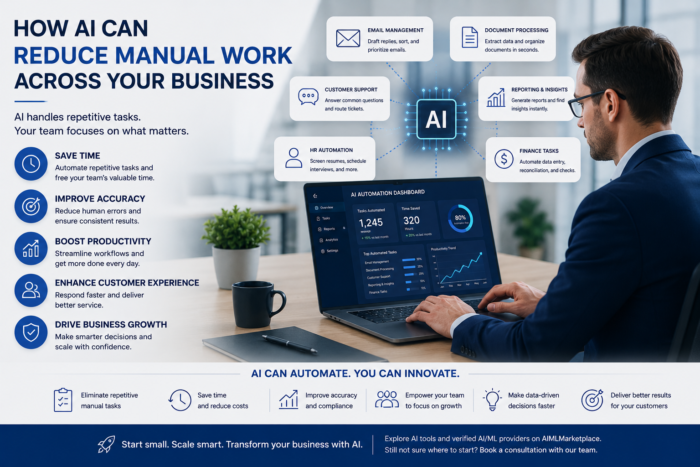
AI can reduce manual work by helping teams summarize information, draft messages, update records, process documents, answer common questions, generate reports, organize tasks, and connect business workflows.
The best place to start is not with the most advanced AI project. It is with the repetitive work your team already does every week.
Simple AI tools may be enough for basic writing, notes, summaries, and task support. Businesses may need an AI provider when AI must connect with CRMs, ERPs, helpdesks, databases, websites, or private company data.
AIMLMarketplace helps businesses compare AI tools and verified AI/ML providers based on workflow needs, industry fit, and implementation goals.
What Does It Mean to Reduce Manual Work With AI?
Reducing manual work with AI means using AI tools or AI systems to handle repetitive tasks that employees currently do by hand.
Here’s the simple way to think about it. Every business has tasks that are predictable, repeated, and time-consuming. These are the tasks AI can help with.
Common examples include:
- Drafting emails
- Summarizing meetings
- Updating CRM notes
- Classifying support tickets
- Pulling data from documents
- Creating reports
- Finding answers from internal files
- Turning notes into tasks
AI is not only about advanced technology. It is about saving time in daily business operations so your team can focus on customers, decisions, and growth.
Why CEOs Should Pay Attention to Manual Work
Manual work quietly affects growth. It rarely shows up as a single problem. Instead, it appears as slow response times, employee overload, small mistakes, delayed reporting, missed follow-ups, poor visibility, extra cost, and less time for strategic work.
Think about a sales team. If reps spend hours updating records, writing follow-ups, and searching through old notes, they have less time to build relationships and close business. Multiply that across departments, and the cost becomes clear.
AI reduce manual work initiatives are not about cutting people. The goal is not to replace the team. The goal is to remove the repetitive work that keeps the team busy.
Where AI Can Reduce Manual Work Across Departments
Table 1: AI Automation for Business – Manual Work Examples
| Department | Manual Work AI Can Reduce | Example Business Benefit |
|---|---|---|
| Sales | CRM notes and follow-up drafts | Faster lead response |
| Customer support | Ticket sorting and reply drafts | Shorter response times |
| Finance | Invoice checks and data entry | Fewer manual errors |
| HR | Resume summaries and onboarding tasks | Faster hiring support |
| Marketing | Content drafts and campaign summaries | Quicker campaign planning |
| Operations | Task updates and status reports | Better workflow visibility |
| Leadership | Report summaries and trend insights | Faster decision-making |
| Admin | Scheduling and document organization | Less repetitive coordination |
| Legal | Document summaries and clause review | Faster first-pass review |
| IT | Knowledge search and ticket triage | Better internal support |
The best AI opportunities are usually found where teams repeat the same task often. AI does not need to automate the whole department at once.
It can start by removing one slow step. Even one small win, like drafting first-pass replies for customer support or summarizing weekly sales calls, can free hours across the team.
Common Manual Tasks AI Can Help Automate
Now let’s make it practical. Here are the tasks where AI productivity tools and AI workflow automation usually create quick value:
- Meeting summaries
- Email drafts
- Customer reply suggestions
- CRM updates
- Lead qualification
- Support ticket routing
- Document processing
- Invoice review
- Report generation
- Internal knowledge search
- Task creation
- Follow-up reminders
- Data cleanup
- Website chatbot responses
A business does not need to automate everything at once. One good workflow can create visible value and build confidence for the next step.
AI Tools vs AI Providers: Which One Do You Need?
Table 2: AI Tool vs AI Provider for Reducing Manual Work
| Comparison Factor | AI Tool | AI Provider |
|---|---|---|
| Best for | Simple repeated tasks | Custom business workflows |
| Setup speed | Usually faster | Depends on scope |
| Customization | Limited to tool features | Built around your process |
| Data access | Basic or standard options | Private and connected data |
| Integrations | Standard connectors | Custom system connections |
| Cost | Lower upfront | Higher but tailored |
| Support | Product support | Strategy and implementation |
| Best-fit buyer | Teams needing quick help | Businesses needing connected workflows |
A CEO should start with an AI tool when the task is simple and standalone, like drafting emails, summarizing notes, or writing product descriptions.
A provider becomes useful when the AI needs to work across multiple systems, follow custom rules, or connect with sensitive business data. That is when an AI implementation partner adds real value.
Explore verified AI tools and AI/ML providers on AIMLMarketplace to compare options that fit your business size, industry, and workflow.
Where Should a CEO Start First?
Here is a simple 5-step approach:
- List the tasks your team repeats every week.
- Identify where work is copied between tools.
- Find where delays hurt customers or revenue.
- Choose one workflow with clear value.
- Decide whether a tool or provider is the right fit.
CEOs should not start with the most exciting AI idea. They should start with the workflow that wastes the most time and has the clearest business impact.
Examples by Industry
Healthcare: AI can help summarize intake forms, organize admin notes, and route routine questions while humans review patient-impacting decisions.
Finance: AI can help review invoices, flag unusual transactions, summarize reports, and reduce repetitive data entry.
Legal: AI can help summarize documents, organize research, and prepare first drafts while legal professionals review important language.
Retail and Ecommerce: AI can help with product descriptions, customer questions, order updates, inventory summaries, and marketing content.
Logistics: AI can help summarize delivery issues, update shipment notes, route support requests, and create operational reports.
Professional Services: AI can help prepare proposals, summarize meetings, organize client notes, and draft follow-ups.
Manufacturing: AI can help summarize production reports, flag maintenance issues, organize quality checks, and support planning.
Mistakes to Avoid When Using AI to Reduce Manual Work
- Buying tools before defining the workflow
- Trying to automate everything at once
- Ignoring data quality
- Forgetting employee adoption
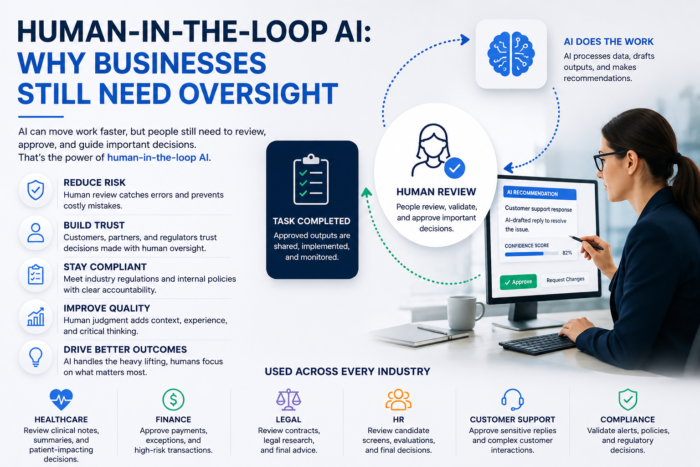
- Using AI without review for high-risk tasks
- Not connecting AI to existing systems
- Measuring activity instead of business impact
- Choosing a provider without clear scope
AI business automation works best when the business problem is clear. Start with the problem, not the tool.
When Should You Hire an AI/ML Provider?
A business may need an AI/ML provider when:
- AI must connect with CRM, ERP, helpdesk, website, database, or internal tools.
- The workflow includes private or sensitive data.
- The business needs custom rules or approval steps.
- The company wants AI agents or advanced automation.
- The team needs reporting, monitoring, or long-term support.
- The internal team does not have AI implementation experience.
Explore verified AI/ML providers on AIMLMarketplace that can help your business reduce manual work with the right mix of AI tools, automation, integration, and custom development.
Simple Checklist Before Starting
- [ ] What manual task does your team repeat every week?
- [ ] Which department spends the most time on repetitive work?
- [ ] Which task affects customers, revenue, or response time?
- [ ] Is the data needed for this task clean and accessible?
- [ ] Does this task happen inside one tool or across many tools?
- [ ] Does the task need human approval?
- [ ] Would a simple AI tool be enough?
- [ ] Do you need custom integration or provider support?
- [ ] How will you measure time saved or improvement?
- [ ] Who inside the company will own the AI workflow?
This checklist helps CEOs avoid buying AI tools randomly and instead focus on a workflow that can create measurable value.
Conclusion
AI can help businesses reduce manual work by handling repetitive tasks across sales, support, finance, HR, marketing, operations, reporting, and administration. The key is to start small. Pick one workflow where your team spends the most time on repeated tasks and where a small improvement would create clear business value.
Simple AI tools may be enough for basic work. When AI needs to connect with your systems, follow custom rules, or handle private data, an AI implementation partner is usually the better path. Either way, the goal is the same — give your team more time for the work that actually grows the business.
Explore AI tools and verified AI/ML providers on AIMLMarketplace to compare options based on your business goals. Still not sure where to start? Book a consultation with our team at https://aimlmarketplace.com/schedule-free-consultation/
Frequently Asked Questions
AI can reduce manual work by handling repetitive tasks like drafting messages, summarizing meetings, updating records, processing documents, answering common questions, and generating reports. Exact results depend on data quality, systems, and adoption.
Start with tasks that are repeated weekly, follow a clear pattern, and do not need heavy judgment. Meeting notes, email drafts, ticket sorting, and report summaries are common first steps.
Yes. Many AI productivity tools are affordable and easy to set up. Small businesses often see quick value in customer support, sales follow-ups, and content drafting.
Use a tool for simple standalone tasks. Choose an AI provider when the workflow crosses multiple systems, uses private data, or needs custom logic and long-term support.
Focus on time saved, response speed, error reduction, and revenue impact. Measure business outcomes, not just AI activity.
Written by: AIML Marketplace Team