If you run a company of 20 to 500 people, AI probably reaches your desk as a stream of separate requests: marketing wants a writing tool, operations saw an agent demo, a vendor is offering a “free” pilot, and someone on the board wants to hear the AI strategy. Each request looks small. Together they become an unplanned budget line with no owner.
This post is the executive view. It gives you a first-90-days plan in three 30-day blocks, the budget guardrails for each block, a one-page usage policy you can adopt this month, and five questions to ask before you approve any AI spend. Vendor selection, build-versus-outsource and integration each have their own guides, linked where they come up.
Why buying a tool first is the expensive way to start
The failure pattern is well documented. A 2024 BCG survey of 1,000 senior executives found that 74% of companies had yet to show tangible value from AI. BCG attributes roughly 70% of implementation challenges to people and process, 20% to technology and only 10% to the algorithms. Gartner predicted that at least 30% of generative AI projects would be abandoned after proof of concept by the end of 2025, citing poor data quality, inadequate risk controls, escalating costs or unclear business value.
None of those causes is fixed by picking a better tool. They are fixed by deciding, before money moves, what problem you are solving, who owns it, what the data looks like and what result would justify continuing. A purchase made first skips all four decisions.
The first 90 days at a glance
The plan is deliberately narrow: one month to learn what you already have, one month to run a single funded pilot, one month to measure and make a decision. Each block has its own spending rule and its own condition for stopping.
| Block | Goal | Spend guardrail | Stop or pause if | What you measure |
|---|---|---|---|---|
| Days 1-30: Inventory and policy | Know what AI is already in use, set the rules, pick one candidate | No new AI contracts. Existing subscriptions continue only if listed in the inventory | No one can be named as owner for any candidate workflow | Baseline for the chosen workflow: time, volume, error rate, cost |
| Days 31-60: One funded pilot | Test AI on one workflow with one accountable owner | A written cap set by you, monthly or cancelable terms, no annual commitment | Spend approaches the cap, data cannot be accessed safely, or the team stops using it | The same baseline metrics, weekly, plus actual spend against cap |
| Days 61-90: Measure and decide | Scale, adjust or stop, based on numbers agreed on day 30 | No expansion spend until the decision memo is signed | Results miss the target agreed before the pilot | Change against baseline, total cost, and review effort required |
Days 1-30: Inventory and policy
Start by finding out what is already happening. In most companies, employees are using AI tools on personal or departmental accounts whether or not anyone approved them.
- Inventory current use. Ask each department head to list every AI tool in use, who uses it, what it is used for, what data goes into it, and what it costs. Include free tiers and features switched on inside software you already pay for.
- Adopt the usage policy (outline below). A rough version on day 10 beats a polished one on day 60.
- Collect friction points. Ask your leadership team where work repeats every week, where customers wait, which reports take days, and where people copy data between systems.
- Pick one candidate workflow that is repeated, stable, measurable and has a willing owner. One is the point. Several parallel pilots split attention and make results harder to read.
- Check the data behind it. Confirm where the data lives, who owns it, how clean it is and whether a tool could reach it within your permission rules. Gartner reported that 63% of organizations either lack, or are unsure whether they have, the right data management practices for AI, and predicted that through 2026 organizations will abandon 60% of AI projects not supported by AI-ready data.
- Record the baseline. Hours per week, turnaround time, error or rework rate, and the cost of doing it today. Without a baseline, day 90 becomes a debate about impressions.
The guardrail for this block is simple: no new AI contracts are signed. That one rule removes the pressure of vendor timelines while you learn what you need.
Days 31-60: One funded pilot with a named owner
Now fund exactly one pilot. Before it starts, put four things in writing, ideally on a single page:
- The owner. One person, by name, who runs the pilot day to day and reports to you. Not a committee and not the vendor.
- The spend cap. A fixed amount covering licenses, setup and any outside help, with a rule that anything above it comes back to you for approval.
- The target. The metric from your baseline and the change that would justify continuing, for example a reduction in hours per week or turnaround time.
- The stop criteria. Conditions that end the pilot early: spend nearing the cap with no measurable movement, data that cannot be accessed safely, or users quietly reverting to the old process.
Prefer monthly or cancelable terms during the pilot. An annual contract signed in week five turns a test into a commitment before you have results.
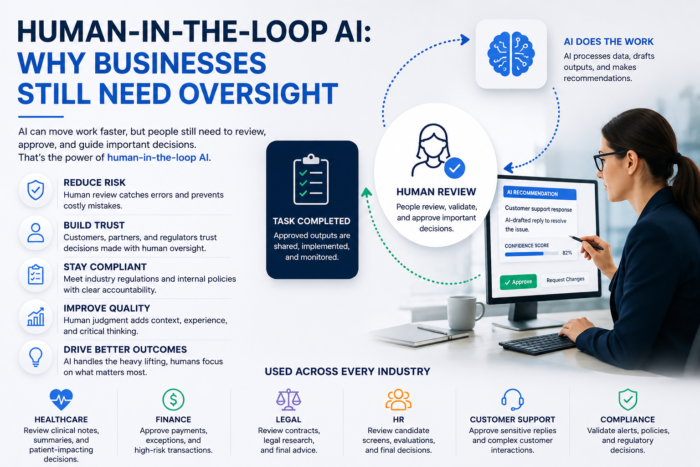
If the pilot involves choosing a SaaS product, the security, pricing and lock-in checks are covered in how to find the right AI vendor. If it needs work done on a process across several systems, see hiring an AI automation company. If any output reaches customers or affects money or hiring, decide where a person reviews it; human-in-the-loop design covers how.
Days 61-90: Measure and decide
Compare the pilot’s numbers with the baseline and the target you wrote down before it began. Count the full cost: licenses, setup, outside help and the internal hours spent reviewing and correcting AI output. A tool that saves ten hours but needs eight hours of checking has not saved much.
Then make one of three decisions, in a short memo the owner drafts and you sign:
- Scale: the target was met and the cost is understood. Approve the next phase with a new cap.
- Adjust: the result is promising but a specific obstacle (data access, training, workflow design) is clear. Approve a fixed extension to fix that one thing.
- Stop: the target was missed. Cancel or downgrade the spend and record why. That record makes the next candidate a better choice.
Hold back on AI agents until a narrower pilot has worked. Gartner has predicted that over 40% of agentic AI projects will be canceled by the end of 2027, citing escalating costs, unclear business value or inadequate risk controls.
A one-page AI usage policy outline
You do not need a governance department. The NIST AI Risk Management Framework is voluntary, organizes the work into four functions (Govern, Map, Measure, Manage), and has a Generative AI Profile (NIST AI 600-1) published in July 2024. Its companion Playbook states plainly that it is not a checklist, so a smaller company can take what fits. The outline below covers the essentials on one page.
- Purpose and owner. One sentence on why the policy exists and the name of the person accountable for it.
- Data that must never go into public or unapproved AI tools:
- Customer and employee personal information
- Financial records, pricing, contracts and bank details
- Passwords, API keys and system credentials
- Source code and proprietary designs, unless the tool is approved for them
- Anything covered by an NDA or a client confidentiality clause
- Health, legal or HR case information
- Approved tools. A short list of tools and account types employees may use, and for what. Business accounts with agreed data terms, not personal sign-ups.
- Approval for new tools. Any new AI tool, plugin or AI feature switched on inside existing software needs sign-off from the policy owner before company data goes into it. Note who approves and what they check (data handling, cost, overlap with existing tools).
- Review of AI output used externally. Anything AI-assisted that goes to a customer, a regulator, the public or a contract must be reviewed by a named person who is accountable for its accuracy, just as if they had written it.
- Disclosure and records. When to tell customers AI was involved, and where AI use for important decisions is logged.
- Reporting problems. How to report a mistake, such as sensitive data pasted into the wrong tool, without fear of blame, and who responds.
- Review date. Revisit the policy at day 90 and then at least yearly.
Five questions to ask before approving any AI spend
Use these for every request, whether it is a single subscription or a custom build. If the person asking cannot answer them, the answer is “not yet.”
- What business problem does this solve, and what does that problem cost us today? In hours, delays, errors or lost revenue, measured, not estimated in the meeting.
- Who owns it? One named person who will run it, report on it and recommend stopping it if it does not work.
- What data does it touch, and is that allowed under our policy? If the answer involves customer, financial or employee data, who has checked how the vendor handles it?
- What result by what date would make us continue, and what would make us stop? Agreed now, not after the money is spent.
- What is the total cost and the exit? Licenses, setup, integration, outside help and internal review time, plus the contract term and what happens to our data if we leave.
Where the detailed decisions live
This plan tells you when and how much. The how is covered elsewhere on the site:
- Building something custom: custom AI development playbook for phases, deliverables and cost drivers.
- Hiring versus outsourcing: AI agency vs in-house developers.
- Connecting AI to your CRM, ERP or helpdesk: AI integration services.
- Off-the-shelf options for smaller teams: AI tools for small business.
If you would rather have outside help running the inventory and choosing the first pilot, you can compare firms in the AI consulting directory.
Frequently Asked Questions
There is no honest universal figure, because cost depends on whether the pilot uses an off-the-shelf subscription or needs integration with your own systems. A better approach is to set the ceiling yourself before any vendor conversation: a fixed amount, a fixed end date, and a written rule that anything above the cap comes back to you. That turns budget into a decision you control rather than a number a vendor proposes.
Not a large one. A smaller company needs a named owner, a one-page usage policy, and a simple approval step for new tools. The NIST AI Risk Management Framework is voluntary and its Playbook is explicitly not a checklist, so you can borrow the parts that fit, such as assigning accountability and inventorying where AI is used, without building a compliance department.
Usually not. Agents act across systems with less human review, which makes them harder to scope, test and cost. Gartner has predicted that a large share of agentic projects will be canceled because of cost, unclear value or weak risk controls. Prove value with a narrower, well-measured pilot first, then consider agents for a workflow you already understand and control.
Stopping is a valid outcome, not a failure of the plan. If you set a baseline and stop criteria up front, a miss tells you something specific: the data was not ready, the workflow was unstable, or the tool did not fit. Write that down, cancel or downgrade the spend, and use the lesson to choose a better second candidate from your inventory.
Written by: AIML Marketplace Team