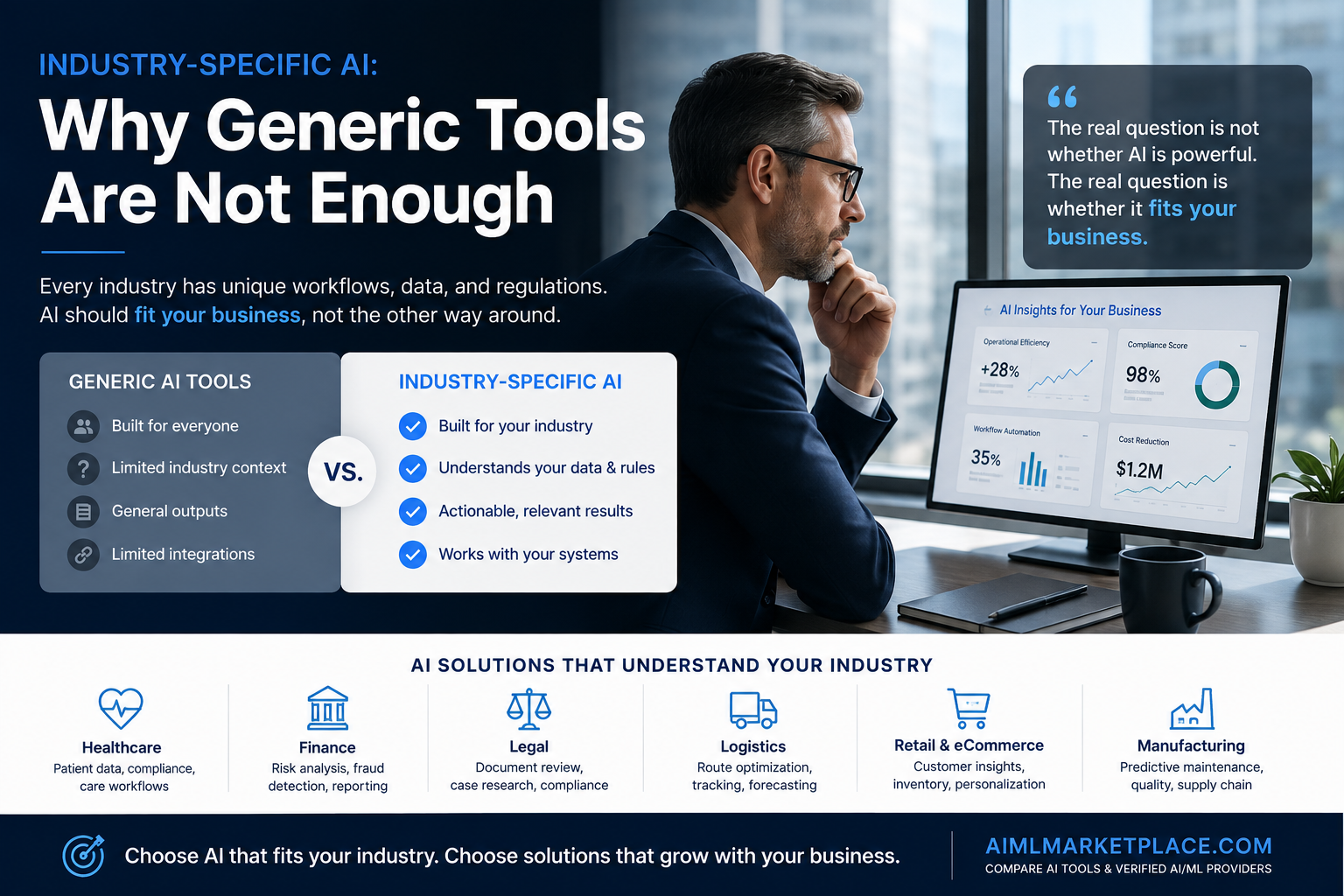
Quick Answer: Generic AI tools help teams write faster, summarize meetings and brainstorm. When a business needs AI that follows its industry rules, works with private data, connects to internal systems and fits specific workflows, generic tools start to fall short. That is where industry-specific AI, AI consulting and custom AI/ML providers come in.
A typical path: a company adopts a popular AI assistant, and it works well for drafting, meeting notes and outreach ideas. Then the questions get harder. Can it read customer records safely? Can it follow our approval process? Does it understand our industry’s rules? Can it connect to the CRM and ERP we already use? Those questions are where industry-specific AI becomes relevant.
What Is Industry-Specific AI?
Industry-specific (or domain-specific) AI is built around the workflows, data, terminology and regulations of a particular sector. A hospital does not run like a bank, and a law firm does not operate like a warehouse. Each has its own vocabulary, compliance obligations and ways of getting work done, so AI for healthcare, finance, legal, logistics, retail and manufacturing ends up looking different in each case.
What Generic AI Tools Do Well
General-purpose tools are a sensible, low-cost starting point for:
- Drafting emails, internal notes and first drafts of content
- Summarizing meetings and long documents
- Brainstorming ideas and outlines
- Organizing simple information
For many companies they are the easiest way to introduce AI without a large investment.
Where Generic AI Tools Fall Short
As work becomes specific to your business, generic tools may not know your industry’s rules, may not connect to your CRM, ERP or helpdesk, may not handle private data under the controls you need, and may not follow your approval workflows. Regulated industries feel this first.
Accuracy on specialist tasks is another gap, and specialization helps without removing the need for review. A 2024 Stanford study of legal research tools found that purpose-built legal AI products made fewer errors than general-purpose models such as GPT-4, yet Lexis+ AI and Ask Practical Law AI still gave incorrect information more than 17% of the time, and Westlaw’s AI-Assisted Research more than 34%. The researchers’ earlier work found general-purpose chatbots hallucinated on 58% to 82% of legal queries.
Examples by Industry
Healthcare: AI can help summarize patient intake information, but decisions that affect care need clinical review. AI that functions as a medical device is regulated; the FDA publishes a list of AI-enabled medical devices authorized for marketing in the United States. Under HIPAA, a covered entity may share protected health information with a vendor acting as a business associate only if it obtains satisfactory assurance that the business associate will appropriately safeguard the information, which rules out many consumer AI tools for patient data.
Finance and insurance: AI can help flag unusual transactions or summarize reports, but accuracy and oversight matter at every step. The EU AI Act lists AI used to evaluate creditworthiness or set credit scores, and AI used for risk assessment and pricing in life and health insurance, as high-risk, which brings additional obligations for systems used in the EU. The same annex covers AI used in recruitment and hiring decisions.
Legal: AI can help review contracts and documents, but attorneys remain responsible for the final work and need to verify citations and language, as the Stanford results above show.
Logistics: AI can help track delays, route requests and summarize shipment issues, but only when it is connected to live operational data.
Retail and ecommerce: AI can help with product descriptions, customer support and demand insights, and it is far more useful when connected to actual store and inventory data.
Manufacturing: AI can support maintenance alerts, quality checks and reporting, provided it reflects real production workflows and equipment data.
AI Tool vs Industry-Specific AI Provider
| Business Need | AI Tool May Be Enough | Provider May Be Needed |
|---|---|---|
| Writing and summaries | Yes | Not always |
| Simple productivity | Yes | Not always |
| Private company data | Sometimes | Usually |
| CRM or ERP integration | Sometimes | Often |
| Industry rules | Limited | Often |
| Custom workflows | Limited | Usually |
| AI agents | Sometimes | Often |
| Long-term support | Limited | Often |
For light, everyday tasks, an AI tool is often enough. Once private data, integrations, industry rules or custom workflows are involved, you usually need an implementation partner for consulting, custom development or integration.
When to Consider Industry-Specific AI
Look beyond generic tools when two or three of these apply:
- The workflow is specific to your industry
- AI needs access to internal or private data
- Several systems (CRM, ERP, helpdesk, website, database) must work together
- Compliance, approvals or audit trails matter
- You need ongoing support, not a one-time setup
Before choosing, answer a few questions: What business problem are we solving? Is it a simple task or a custom workflow? Can ready-made AI tools handle it, or do we need a consultant or provider? How will we measure success?
How AIMLMarketplace Helps
AIMLMarketplace lets you compare AI tools and AI/ML providers in one place. If your needs are simple, start with ready-to-use tools. If your work involves custom workflows, private data or industry rules, compare providers that specialize in AI consulting, integration, automation, generative AI, chatbots, NLP and data analytics, and shortlist them by industry and goals before you commit.
Conclusion
Generic AI tools are useful, but they are not always enough. When your business depends on specific workflows, private data, industry rules or connected systems, industry-specific AI is usually the better fit. The question is not whether AI is powerful, but whether it fits how your business works and the rules it operates under.
Explore AI tools and AI/ML providers on AIMLMarketplace to compare options by industry, workflow and business goals. Not sure where to start? Book a free consultation.
Frequently Asked Questions
It is AI designed around the workflows, data, rules, and customers of a specific industry, like healthcare, finance, legal, retail, or manufacturing.
Yes. They are great for writing, summarizing, brainstorming, and everyday productivity. They are often the easiest way to start using AI.
When AI must work with private data, connect to internal systems, follow industry rules, or support custom workflows across teams.
It lets you compare AI tools and verified AI/ML providers side by side, so you can shortlist the right fit for your industry and goals.
Written by: AIML Marketplace Team



 Free Consultation call: your goals, timeline, and ballpark budget