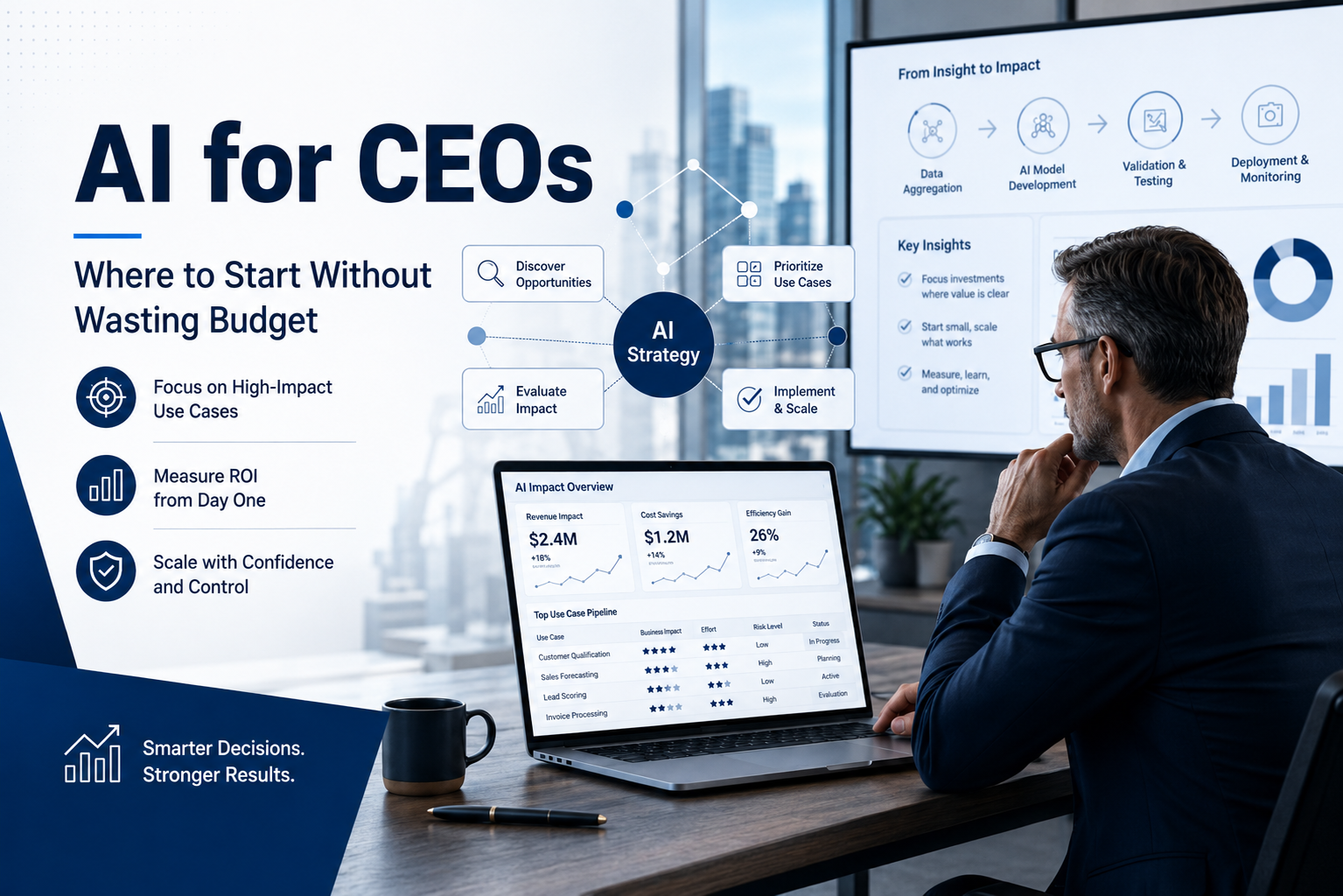
A CEO’s week can include a pitch for an AI writing tool from marketing, an agent demo from operations, a report on AI in finance from the CFO, and a board asking about the company’s “AI strategy.” Underneath all of it is one practical question: where should we start without wasting money?
Quick Answer
Start with a business problem, not a tool. Find where the company loses time, money, speed or customer goodwill to repeated manual work, and pick one of those problems to fix first. Off-the-shelf AI tools often cover writing, summaries, meeting notes and basic reporting. When AI has to connect to business systems, use private data, or run custom workflows, you will usually need an AI consultant or one of the AI/ML providers.
Why Starting With a Tool Wastes Budget
The pattern is well documented. Gartner predicted that at least 30% of generative AI projects would be abandoned after proof of concept by the end of 2025, citing poor data quality, inadequate risk controls, escalating costs or unclear business value. A 2024 BCG survey of 1,000 executives found that 74% of companies had yet to show tangible value from AI. BCG attributes about 70% of implementation challenges to people and process issues, 20% to technology, and only 10% to the AI algorithms themselves.
Inside a company, that usually looks like this:
- Licenses bought after a demo, with no one owning the rollout
- No success metric agreed before the project starts
- Workflows left unchanged, so employees keep working the old way
- Overlapping tools bought separately by different departments
- A broken process automated as-is, which only produces bad output faster
- Pilots with no plan, budget or owner for moving into production
The better question is not “Which AI tool should we buy?” but “Which business problem should AI solve first?”
Where CEOs Should Look First
Look for friction in how work already flows through the business. Ask your leadership team:
- Where do we repeat the same work every week?
- Where do customers wait too long?
- Which reports take days to prepare?
- Where do decisions stall while people wait for information?
- Where do employees copy and paste data between tools?
A clearly defined, repeated workflow that shows up in these answers is a good candidate. The same functional areas tend to come up across industries:
Where to Look First, by Business Area
| Business Area | What to Review | AI Opportunity |
|---|---|---|
| Sales | Follow-ups and CRM updates | Faster lead response |
| Customer support | Repeated questions and tickets | Quicker support handling |
| Finance | Invoices and reporting | Fewer manual checks |
| HR | Screening and onboarding | Faster admin support |
| Marketing | Content and campaign planning | Quicker content drafts |
| Operations | Status updates and task tracking | Better workflow visibility |
| Leadership | Reports and dashboards | Faster access to decision data |
| Admin | Scheduling and documentation | Less coordination work |
Do not tackle every row at once. Pick one area where the pain is clearest and the workflow is stable. One use case with a measurable result is a better first project than several parallel pilots, and it gives you a template for the second and third.
AI Tool, AI Consultant, or AI/ML Provider?
Not every problem needs a custom build, and not every problem can be solved with an off-the-shelf product.
AI Buying Path for CEOs
| Need | Best Fit | Why |
|---|---|---|
| Simple writing help | AI tool | Fast and easy to test |
| Meeting summaries | AI tool | Low setup effort |
| Workflow planning | AI consultant | Helps define priorities |
| System integration | AI provider | Connects AI with existing tools |
| Custom automation | AI/ML provider | Builds around your process |
| Private data use | AI provider | Requires secure setup |
| Long-term AI roadmap | AI consultant | Guides strategy and adoption |
| AI agents | AI/ML provider | Needs controls and monitoring |
A tool fits a simple, self-contained task. A consultant helps when strategy is unclear or priorities compete. A provider is the right choice when AI must be built, integrated, customized or supported over time. Most companies end up with a mix: a few tools for daily productivity, plus outside help for work that touches core systems and private data.
Treat AI agents as a later step. Gartner predicts that over 40% of agentic AI projects will be canceled by the end of 2027 because of escalating costs, unclear business value or inadequate risk controls, and recommends pursuing agentic AI only where it delivers clear value or ROI.
Check Data Readiness Before You Buy
In a 2024 Gartner survey of 1,203 data management leaders, 63% of organizations said they either do not have, or are unsure whether they have, the right data management practices for AI. Gartner predicts that through 2026, organizations will abandon 60% of AI projects that are not supported by AI-ready data. Before signing a contract, confirm where the relevant data lives, who owns it, how clean it is, and whether a tool or provider can access it within your security and permission rules.
Assign Ownership and Governance Early
Any AI that touches customer data, finances or hiring needs a named internal owner, defined review and approval steps, and clear permissions. The NIST AI Risk Management Framework, a voluntary framework released in January 2023 and extended with a generative AI profile in July 2024, organizes this work into four functions: Govern, Map, Measure and Manage. It is a practical reference even for companies without a dedicated AI team.
What AI ROI Should CEOs Measure First?
Measure business outcomes, not activity. “We ran five pilots” is not a result. Track:
- Time saved on repeated tasks
- Customer response and resolution times
- Error rates in reports and data entry
- Reporting cycle time
- Sales cycle speed and revenue supported
- Cost avoided from reduced manual work
Set a baseline before the project starts and agree when you will review it, for example at 30, 60 and 90 days.
CEO Checklist Before Buying Any AI Tool
- What business problem are we solving, and which team feels it most?
- How much time or money does it cost us today?
- Is the workflow repeated and stable?
- Is the data clean and accessible enough to use?
- Does the task happen in one tool or across several systems?
- Where does a human need to review or approve?
- Would a simple AI tool be enough, or do we need consulting, integration or custom development?
- Who owns the project internally, and how will we measure success?
If your team cannot answer these clearly, answering them is the real first step.
When to Hire an AI Consultant or AI/ML Provider
Consider outside help when:
- You do not know where AI should start
- AI needs to connect with your CRM, ERP, helpdesk, database or website
- The work involves private or sensitive business data
- Automation has to span several departments
- You need governance, review or approval workflows
- You want a long-term adoption roadmap but have no internal implementation team
Compare several providers on relevant experience, security practices and support terms, not just price.
How AIMLMarketplace Helps
AIMLMarketplace lets CEOs, founders and operations leaders compare options in one place instead of taking vendor calls one by one. You can review AI tools for everyday productivity and browse AI/ML providers for consulting, custom development, business automation and agents, data analytics and BI, generative AI, and NLP and chatbots. Understanding the difference between tools and providers before committing budget is the step most companies skip.
Conclusion
AI for CEOs is not about chasing every new tool. Choose one clear business problem, check that the data and workflow are ready, assign an owner, measure the result, and expand only when the value is proven.
Explore AI tools and AI/ML providers on AIMLMarketplace to compare options against your business goals. Not sure where to start? Book a free consultation.
Frequently Asked Questions
Start with a clear business problem, not a tool. Pick one repeated workflow that wastes time or slows customers down, and test AI there first.
Define the problem, assign an owner, set a success metric, check data quality, and choose the smallest first project that shows real value.
An AI tool works for simple tasks like writing or summaries. A consultant or AI/ML provider is better when AI must connect to systems, private data, or custom workflows.
Usually one that reduces manual work, speeds up customer response, or shortens reporting cycles. It should be repeated weekly and easy to measure.
Measure business outcomes: time saved, faster response, fewer errors, better reporting speed, improved productivity, and stronger customer experience.
Written by: AIML Marketplace Team