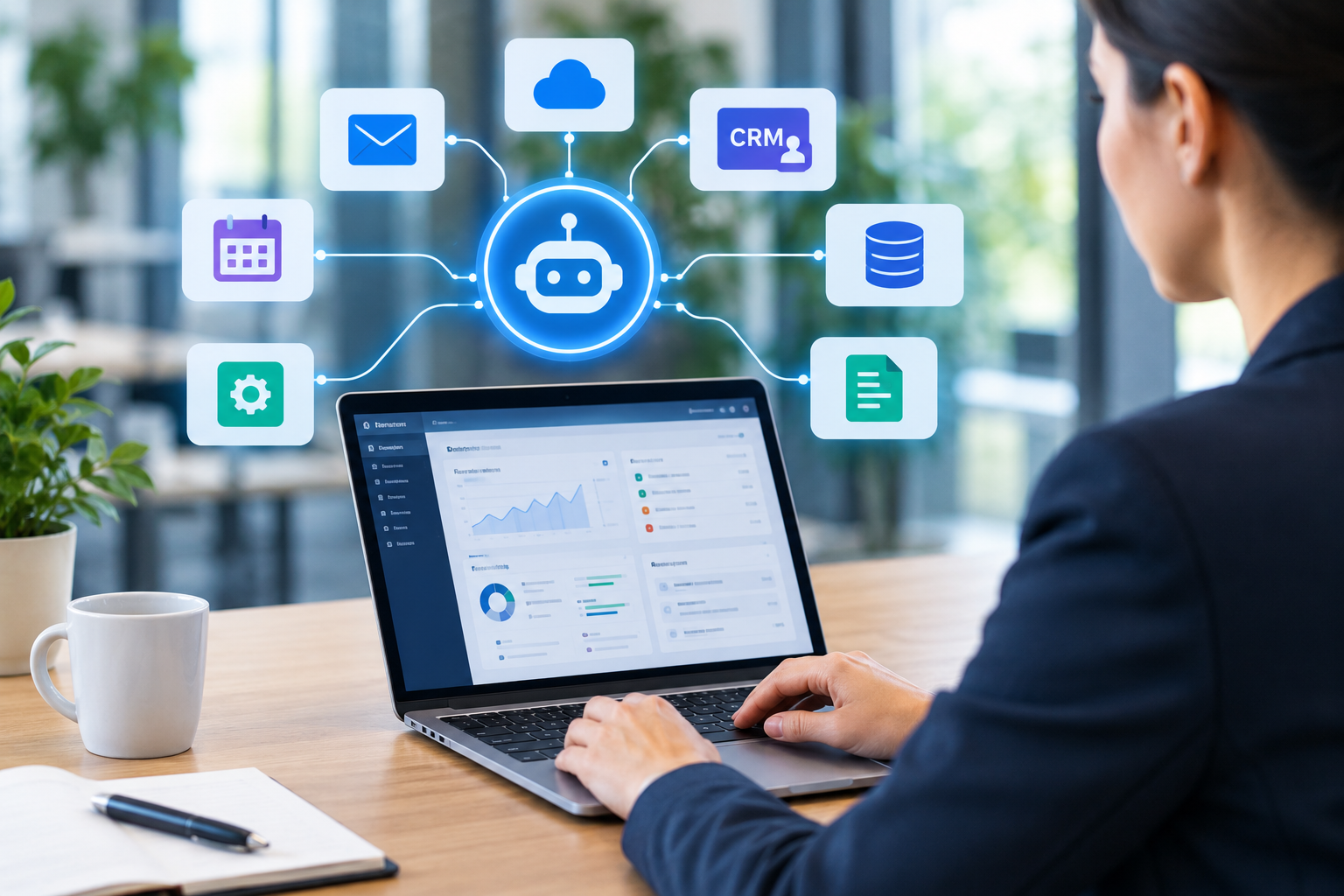
Imagine a customer sends a support request, but instead of waiting for an employee to read it, classify it, find the relevant information, and prepare a response, an AI-powered system handles the routine steps automatically. It checks the request, retrieves relevant details, drafts a reply, and sends the case to a human when a decision requires further attention.
This is one example of what AI agents can do.
AI agents are becoming an important area of business automation because they can do more than generate text or answer questions. Depending on how they are designed, they can work toward a defined goal, use approved tools, retrieve information, and complete multiple steps within a business process.
However, giving an AI system access to business tools also introduces new risks. An agent that misunderstands a request or uses the wrong information can create problems just as quickly as it can save time.
For businesses considering this technology, the important question is not simply whether AI agents are useful. It is which tasks they should handle, what access they need, and how their work can be checked.
What Is an AI Agent?
An AI agent is a software system that uses AI to interpret information, decide what action to take within its design, and work toward a specified objective. Some agents can use external tools, access approved data sources, and carry out a sequence of actions without requiring a separate instruction for every step.
For example, a sales operations agent might review incoming inquiries, extract relevant details, check an approved customer database, and prepare a summary for a sales representative.
The agent is not necessarily making every decision independently. Its behavior depends on the underlying model, instructions, available tools, permissions, and workflow rules.
It is also important to distinguish AI agents from ordinary automation. A traditional automation workflow might follow a fixed sequence of steps. An AI agent can interpret less structured information and select among permitted actions based on the situation.
Both approaches have their place. If a task follows predictable rules, conventional automation may be cheaper, easier to test, and more reliable. An AI agent becomes more useful when the task involves interpreting language, gathering information from different sources, or handling variations that are difficult to describe with fixed rules alone.
How Do AI Agents Work?
The design of an AI agent varies by application, but a typical system includes several components.
1. A defined goal
The agent receives an objective, such as preparing a customer support summary, researching a sales lead, or identifying missing information in a document.
A well-defined goal helps prevent the system from taking actions that fall outside its intended purpose.
2. Context and information
The agent may need information from company documents, databases, customer records, or other approved sources.
For instance, a support agent may need access to product documentation and a customer’s order status. The quality and relevance of this information directly affect the usefulness of its output.
3. Reasoning and task planning
The AI model interprets the request and determines which steps may be needed. Depending on the implementation, it may break a task into smaller actions, select a tool, or ask for additional information.
This planning process is not a guarantee of correct reasoning. The agent can misunderstand instructions, overlook important details, or choose an inappropriate action.
4. Tools and integrations
An agent may interact with approved software through APIs, database queries, search tools, or business applications.
For example, it could retrieve information from a CRM system and prepare a draft follow-up email. Sending that email or changing a customer record should depend on the permissions and approval rules configured for the system.
5. Results and verification
After performing an action, the agent may check the result and determine whether additional steps are needed.
A reliable implementation should also record important actions, handle failures, and provide a clear way to escalate tasks that it cannot complete confidently.
AI Agents vs. Chatbots vs. Traditional Automation
These terms are often used interchangeably, but they describe different approaches.
Traditional automation follows predefined rules and workflows. It is well suited to repetitive tasks with predictable inputs and outputs.
A chatbot primarily interacts with people through conversation. Some chatbots are simple rule-based systems, while others use large language models to answer questions and understand natural language.
An AI agent can combine conversation, information retrieval, planning, and tool use to complete a multi-step task. Some agents operate in the background rather than communicating directly with a user.
Consider a customer who wants to know the status of an order.
A traditional automation might retrieve the order status when it receives a valid order number. A chatbot might explain how to check an order. An AI agent might interpret the customer’s request, retrieve the relevant order information, summarize the status, and initiate an approved follow-up action if the order appears delayed.
In practice, these systems can overlap. A business may combine a chatbot with an agent and conventional automation rather than choosing only one technology.
Practical AI Agent Use Cases for Businesses
The most useful applications often begin with a narrow workflow that consumes employee time or involves repeated information gathering.
1. Customer support and service operations
Customer support agents can classify incoming tickets, search knowledge bases, summarize previous conversations, and prepare responses based on approved documentation.
For example, an agent could review a request about a missing shipment, retrieve the relevant order details, check the documented delivery status, and prepare a response for a support representative.
This can reduce the time spent gathering information. However, refunds, account changes, complaints, and other sensitive actions may require explicit approval or additional verification.
2. Sales research and lead qualification
Sales teams often spend considerable time researching prospects, reviewing incoming inquiries, and updating CRM records.
An AI agent could organize information supplied through a lead form, identify missing details, summarize the prospect’s stated requirements, and prepare a briefing for a salesperson.
Businesses should be careful about the source and accuracy of prospect information. An agent should not invent company details or treat an inferred buying intention as a verified fact.
3. Internal knowledge and employee assistance
Employees frequently search across policies, technical documentation, project notes, and internal knowledge bases.
A knowledge agent can retrieve relevant material, summarize it, and link the answer to its supporting documents. This can make information easier to find without requiring employees to navigate several systems manually.
Access permissions are particularly important here. The agent should not expose confidential documents to an employee who would not otherwise be allowed to view them.
4. Document processing
Businesses receive invoices, forms, contracts, reports, and other documents in different formats.
An AI agent can extract information, compare fields against predefined requirements, flag missing details, and route documents for review.
For example, a procurement team might use an agent to identify invoices that lack a purchase order reference. The agent can flag the discrepancy, but a financial approval or payment should remain subject to the organization’s established controls.
5. Software development and IT operations
AI agents can assist development teams by analyzing error logs, locating relevant documentation, suggesting code changes, and preparing test cases.
In IT operations, an agent may help classify incidents and recommend troubleshooting steps.
The level of autonomy matters. Suggesting a configuration change is different from applying it to a production server. Changes that could cause downtime, data loss, or security problems should have appropriate testing, access restrictions, and approval procedures.
6. Research and business reporting
An agent can gather information from approved sources, organize findings, compare records, and prepare a structured report.
A business development team, for example, might use an agent to summarize information about a group of potential partners before a meeting.
The output should identify its sources and distinguish verified information from assumptions. Research agents can return incomplete or outdated findings, so important claims still require human review.
What Are the Benefits of AI Agents?
AI agents can provide practical benefits when they are matched to the right tasks.
- Less repetitive work: Employees may spend less time collecting information, categorizing requests, and preparing routine summaries.
- Faster workflows: Several information-gathering steps can be coordinated within one process.
- Consistent procedures: Agents can follow defined instructions and use approved resources across recurring tasks.
- Support for employees: Staff can receive summaries, recommendations, and relevant information without manually searching every source.
- More flexible automation: Natural-language understanding can help workflows handle requests that do not arrive in a perfectly standardized format.
These benefits depend on the quality of the implementation. An agent may introduce extra work if employees have to correct inaccurate outputs, investigate unexpected actions, or maintain complicated integrations.
Businesses should therefore measure actual task completion time, error rates, human intervention, and total operating cost rather than assuming that greater autonomy automatically means greater efficiency.
What Are the Risks of Using AI Agents?
An AI agent can interact with real business systems, which makes its permissions and operating boundaries especially important.
Incorrect information and decisions
An agent may generate a plausible but incorrect answer or select the wrong action. Systems that handle customer records, financial information, or operational decisions need validation steps appropriate to the consequences of an error.
Excessive access permissions
Giving an agent access to every available system increases the potential impact of mistakes or misuse. Access should be limited to the specific information and actions required for its assigned task.
Prompt injection and untrusted content
An agent may encounter instructions embedded in emails, webpages, uploaded files, or other external content. Such content could attempt to manipulate the agent into ignoring its intended rules or revealing information.
Developers should treat external content as untrusted, separate instructions from retrieved data, restrict tool permissions, and test the system against malicious inputs.
Uncontrolled actions
An agent that can send messages, update records, delete files, or initiate transactions may cause harm if it acts on an incorrect interpretation.
Important actions should have suitable safeguards, such as approval requirements, spending limits, confirmation steps, and the ability to reverse changes where possible.
Privacy and compliance
Business agents may process personal, financial, or confidential information. Organizations need to understand how data is stored, transmitted, retained, and used by the underlying AI service.
Privacy obligations, contractual requirements, and applicable regulations should be considered before deploying an agent.
Unpredictable operating costs
Agents that repeatedly call AI models, search databases, or use external tools can consume more resources than expected. Complex tasks may involve several model calls before completion.
Businesses should monitor usage, set budgets and limits, and test common as well as unusually complex scenarios before making a workflow widely available.
How to Implement AI Agents in Your Business
A successful project usually starts with a specific operational need rather than a decision to adopt agents simply because the technology is attracting attention.
Step 1: Select a suitable task
Look for a recurring process that involves gathering information, interpreting requests, or preparing work for an employee.
A good first project has a clear objective, manageable consequences if something goes wrong, and a way to measure improvement.
Step 2: Map the existing workflow
Document how the task is completed today, including the systems involved, decisions employees make, common exceptions, and approval requirements.
This helps identify where an agent can contribute and where conventional automation or a process change may be more appropriate.
Step 3: Define permissions and boundaries
Specify what information the agent can access, which tools it can use, and which actions it is allowed to perform.
For an initial deployment, it may be sensible to let the agent retrieve information and prepare recommendations while an employee approves consequential actions.
Step 4: Connect the required systems
Integrations may involve a CRM, help desk, internal knowledge base, document repository, or other business software.
Each integration should be tested for authentication, access permissions, error handling, and the reliability of the data returned.
Step 5: Test realistic scenarios
Evaluate the agent using normal requests, incomplete information, unusual cases, incorrect assumptions, and potentially malicious instructions.
Measure whether it completes the task correctly, follows permissions, identifies uncertainty, and escalates situations it cannot handle safely.
Step 6: Launch gradually and monitor performance
Start with a limited group of users or a small portion of the workflow. Review errors, operating costs, employee feedback, and the amount of human intervention required.
Expand the system only when the results justify broader use.
How to Choose an AI Agent Development Company
Businesses may need outside expertise to design an agent, integrate it with existing applications, and establish suitable security controls.
When evaluating AI agent developers or service providers, ask the following questions.
Business process experience: Can the provider explain how it would approach your particular workflow, including exceptions and approval steps?
Integration capabilities: Has the team worked with the APIs, databases, and applications your business already uses?
Security approach: How will access permissions, credentials, sensitive information, and untrusted input be managed?
Evaluation and testing: How will the provider measure accuracy, task completion, failure rates, and reliability before deployment?
Human oversight: Which actions require approval, and how will the system escalate uncertain or sensitive cases?
Cost transparency: Does the proposal explain model usage, infrastructure, third-party services, integration work, and ongoing maintenance?
Ownership and support: Who owns the code and related deliverables? What documentation, monitoring, and post-launch assistance will be provided?
A provider should be able to explain the limitations of its proposed solution as well as its potential advantages. Be cautious of claims that an agent can automate an entire department without meaningful oversight or that it will always produce correct results.
AIML Marketplace helps businesses discover and compare AI service providers. Businesses exploring agent development can use a provider directory as a starting point for researching potential partners, then assess their capabilities, experience, security practices, and suitability for the intended project.
Final Thoughts
AI agents offer businesses a way to connect AI capabilities with everyday work. They can help gather information, organize documents, support employees, and coordinate selected tasks across existing systems.
However, successful implementation requires more than choosing a capable AI model. Businesses need clearly defined objectives, reliable integrations, restricted permissions, appropriate human oversight, and ongoing performance monitoring.
The most practical starting point is usually a small, measurable workflow where an agent can demonstrate value without being given unnecessary authority. Once the results are understood, the organization can decide whether to expand the implementation or explore more advanced agent-based systems.
For businesses evaluating this technology, the goal should be to find an AI agent solution that fits the actual workflow, delivers measurable improvements, and operates within clear technical and business boundaries.
Frequently Asked Questions
Not necessarily. Some agents perform limited tasks with little intervention, while others require approval at several stages. Their autonomy depends on the workflow, available tools, permissions, and safeguards established by the developer.
No. Some agents use large language models to interpret natural language and plan tasks, while others rely on smaller models, specialized algorithms, or a combination of techniques. The appropriate design depends on the problem being solved.
Yes, when suitable integrations are available. Agents may connect to business applications through APIs or other approved interfaces. Integration feasibility depends on the software, authentication methods, data access, and required actions.
They can be, particularly when a business has a well-defined repetitive task and a clear way to measure the result. Smaller organizations should consider setup costs, subscription fees, integration effort, and the time required to monitor the system.
A single-agent system uses one primary agent to perform a task or coordinate its steps. A multi-agent system uses multiple agents with different responsibilities that exchange information or coordinate work.
A multi-agent design can help with some complex workflows, but it also introduces coordination overhead, more opportunities for errors, and potentially higher costs. Using multiple agents is not automatically better.
Useful measurements include average task completion time, error rate, percentage of tasks completed successfully, frequency of human intervention, operating cost per task, and user satisfaction.
The right metrics depend on the business objective. A support agent, for example, should be evaluated on the quality and resolution of support requests rather than the number of messages it generates.
Written by: AIML Marketplace Team
